I've always liked figuring things out.
I'm Anthoney. I coach strength, movement, nutrition, and recovery. I got here by following a long-running interest in how things work, and I still enjoy the part where something finally clicks for a person.
Where it started
As a skateboarder, I liked helping friends land tricks. I'd watch a few attempts, point out something to try, and see if it helped. Later, working as a mechanic taught me to slow down and understand a problem before trying to solve it.
I still like that process: pay attention, ask a better question, try something, and check what changed. Coaching gave me a way to spend my working life doing it.
I started college on a pre-med path, then found myself more interested in training and everyday health. I finished with a Bachelor's spanning Biology, Psychology, and Exercise & Sport Science. That mix still shapes the questions I ask about training, habits, and recovery.
Still learning
Since then I've put north of $115,000 of my own money into education and certifications — a degree, two CHEK programs, an FRC certification, a dozen-plus other courses, and somewhere past 400 books. On top of that sit fifteen years of hours I've never tried to price: the reading, and the years of coaching people for free while I learned what actually worked. I've also tested countless diets and training protocols on myself before ever asking a client to try one. That includes climbing out of my own unhealthy-eating background: fried everything, white bread, sugar. I know what the rebuild feels like from the inside, because I've done it.
Where that $115,000 goes — the itemized list (click to open)
I'd rather show you this than ask you to take my word for it.
| B.G.S. spanning Biology, Psychology, and Exercise & Sport Science | $80,000+ |
| CHEK Academy coursework — two programs | $10,000 |
| Functional Range Conditioning certification | $1,000 |
| A further 10–20 courses and certifications, $500–$1,000 each | $5,000+ |
| ~50 textbooks at roughly $200 each | $10,000 |
| ~350 further books on training, nutrition, and physiology | $5,250 |
| Conservative total | $115,000+ |
That's money, and money is the part I can put a number on. The fifteen years of hours behind it — reading, coursework, and the years of coaching people for free while I learned — I'm not going to price for you and call it an investment. You can decide what that's worth.
My own experience gives me perspective, but it doesn't tell me what will work for you. That's why we start with your history and keep checking your progress.
Training happens in a whole life.
A training plan has to work alongside your food, sleep, stress, and schedule. Paul Chek's work helped shape that view for me. I want to understand those things before deciding how much training to ask of you.
Everything connects
A rough week of sleep can change what a sensible session looks like. I want to know how the rest of your week is going so we can account for it.
Assessment before programming
I look at your movement, training history, and current routine before writing your personal program. It gives us a starting point we can return to.
Your circumstances matter
Your goals, available equipment, and experience help determine your plan. We adjust it as those things change.
Know when to ask for help
Some questions need a physician, physical therapist, or another specialist. When that's the case, I want the right person involved.
A coach who knows his lane
My work is strength, movement, nutrition, and lifestyle coaching. Medical decisions belong with your clinical team. Here's how I work alongside them:
- As a nutritionist, I recommend — I don't prescribe. You get evidence-based guidance, never a script that belongs in a doctor's hands.
- I can arrange blood panels — and review them with medical providers, not in place of them. Your labs get coaching context and clinical eyes.
- I keep a referral network — psychologist, physical therapist, medical providers — and I route clients out the moment something is beyond my scope.
If a question is outside my scope, I'll tell you and help you find the right support.







Away from coaching
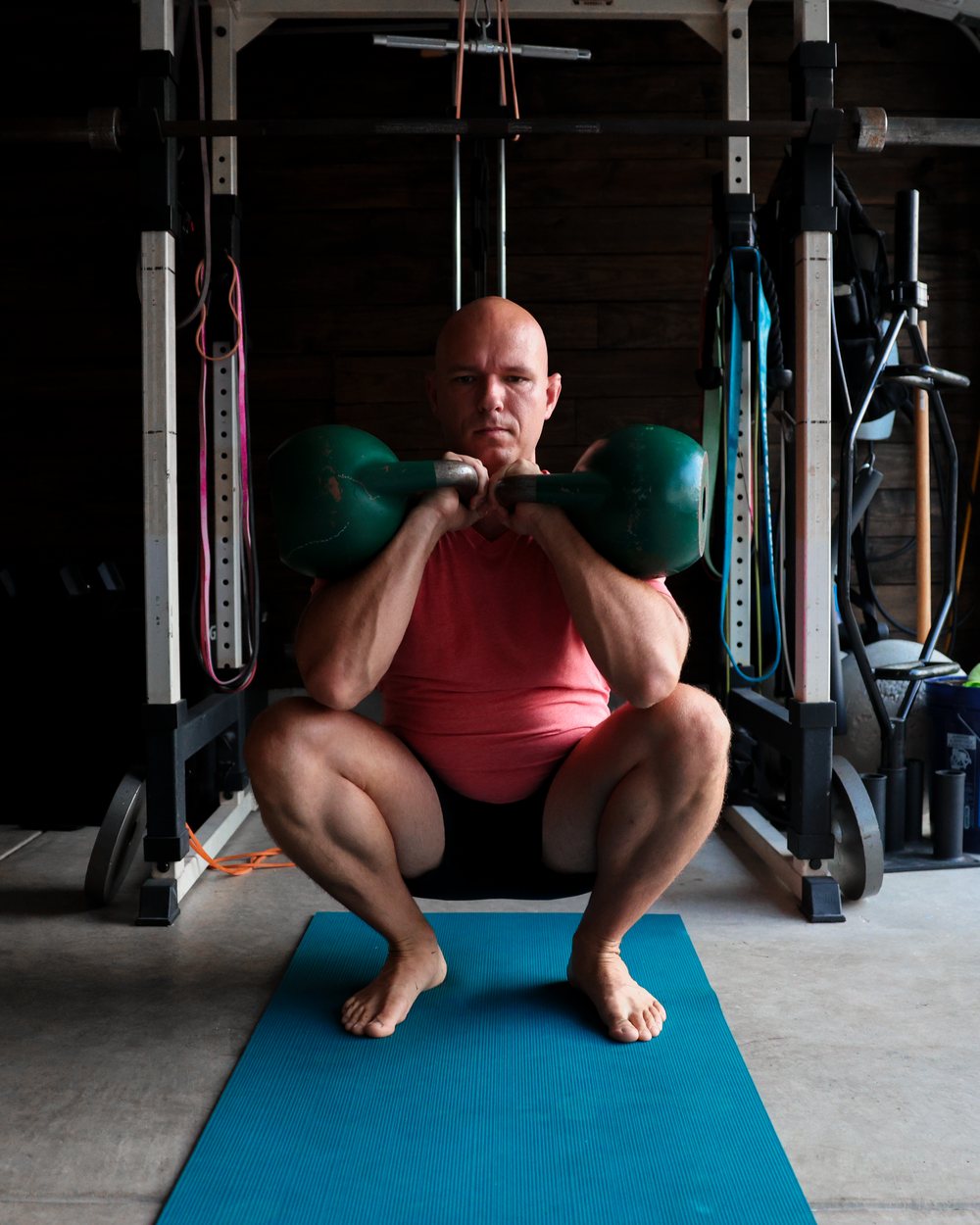
I love to travel. The kettlebells and bands tend to come with me, and I'll usually have a few places to eat picked out before we arrive. Training matters to me, but so does having the time and energy to enjoy everything around it.
The best way to know if we fit
is a conversation.
Tell me what you'd like help with and ask whatever you need to ask. We can work out whether the Blueprint fits your situation.
Apply for Coaching →